





In 1940, the United States hadn’t yet entered the war after the War to End All Wars, but two comics creators didn’t like what they were seeing. Two young Jewish men, who were born Hymie Simon and Jacob Kurtzberg, but who changed their names to Joe Simon and Jack Kirby to better assimilate, saw what the Axis powers were doing to Europe in general and to their fellow Jews in particular, and were angry and frightened.
And so, in December 1940, Captain America #1 debuted. Dressed in a costume with a flag motif and carrying a red-white-and-blue shield, the cover of the first issue had Cap punching Adolf Hitler in the face. The character was very polarizing—Simon and Kirby got several death threats interspersed with the avalanche of fan mail, as there were plenty of people in this country who wanted to stay the hell out of the fighting overseas—but ultimately proved hugely popular, especially after the bombing of Pearl Harbor a year later put the U.S. in the war.
After an awful movie serial in 1944, two terrible TV movies in 1979, and a 1990 film that never got (or deserved) a theatrical release, Captain America finally got a proper feature film seventy years after Pearl Harbor.
Captain America was by far Timely Comics’s most popular character, inspiring a fan club (the Sentinels of Liberty) and tons of other merchandise, not to mention that crummy movie serial. After World War II ended, however, his popularity waned, with his title ending in 1949. They revived the character in 1953 and showed him fighting Communist agents, but it only lasted a year.
When Timely—becoming known better as Marvel Comics—started their little superhero revolution in the early 1960s, Kirby and Stan Lee decided to bring Cap back in Avengers #4, establishing that he was in suspended animation in the Arctic since the end of the war. (The 1950s version of Cap and his sidekick Bucky was ignored initially, and then retconned in a 1972 story by Steve Englehart as a pair of knock-offs. That Cap and Bucky went nuts, with Cap dying, and Bucky being cured of his insanity and becoming the hero Nomad.)
Cap quickly became the heart of the Avengers, and also thrived in his own adventures. Initially sharing the Tales of Suspense title with Iron Man, with the hundredth issue in 1968 it was retitled Captain America, with Iron Man getting his own separate title.
Marvel’s attempts to do Cap right on film in the 21st century were stymied initially by a lawsuit brought about by Simon over rights to the character (Marvel and Simon eventually settled), and then by the writers strike of 2007. Eventually, however, the film got greenlit. The original intent was to have half the film take place during World War II and the other half in the present day, but that was quickly abandoned for a straight-up WWII pic. (Perhaps they recalled that that formula didn’t exactly work the last time they tried it.) Joe Johnston—who had directed October Sky and The Rocketeer, both period pieces—was hired to direct, and he brought in Christopher Markus and Stephen McFeely to write the script. Markus and McFeely have since become two of the go-to writers of the Marvel Cinematic Universe—they would go on to write the subsequent two Cap films, the two Avengers: Infinity War movies, and Thor: Dark World.
Buy the Book
Zero Sum Game
Chris Evans was cast in the title role, for which Ryan Philippe, John Krasinski, and Sebastian Stan were also considered. Stan wound up being cast as Bucky, with Hayley Atwell as Peggy Carter, Tommy Lee Jones as Colonel Phillips (a minor character in one of the 1960s expanded retellings of Cap’s origin), Stanley Tucci as Dr. Erskine, Hugo Weaving as the Red Skull, and Toby Jones as the Skull’s right hand Arnim Zola (in the comics, Zola is a geneticist who experimented on his own body, giving him a face on a TV screen in his chest—there’s a visual reference to that in the movie). Returning are the characters of Howard Stark from Iron Man 2, played as a younger man by Dominic Cooper, and Samuel L. Jackson from Thor as Nick Fury. Neal McDonough, Derek Luke, Kenneth Choi, Bruno Ricci, and JJ Feild play the Howling Commandos, though they’re never referred to as such.
Originally, the Howling Commandos were a diverse group of soldiers under the leadership of Sergeant Nick Fury, who would go on twenty years after the war to become the head of S.H.I.E.L.D., with several of his commandos working for him at the spy agency as well. The Fury connection is dropped for the movie, with the team led by McDonough’s “Dum Dum” Dugan, complete with trademark mustache and bowler hat from the comics.
Bucky’s backstory was changed from the comics as well, using elements of the “Ultimate” line’s version of Bucky, and also combining the mainline Bucky with that of Arnold Roth, who was established as Rogers’s childhood friend who protected him from bullies, as Bucky does here.
And the Red Skull was altered—while he keeps the comics’ version’s real name of Johann Schmidt, he is no longer a lower-class citizen raised to prominence by Adolf Hitler with no special powers. Instead, he’s a scientist who leads Hydra (thus combining the Skull with Baron Wolfgang von Strucker, who ran Hydra during the war in the comics), and he also is given the Super Soldier Serum that is later given to Rogers, though it has the side effect of turning his skin red and his face into a skull shape. (In the comics, the Red Skull is a normal-looking person wearing a mask.)
Also, for reasons passing understanding, Rogers’s home neighborhood was changed from the Lower East Side—the section of Manhattan where Jack Kirby was born and raised—to Brooklyn for no compellingly good reason. Since the character’s co-creator was from the Lower East Side, to move his home to Brooklyn seems pointless and arbitrary, and an insult to “King” Kirby, especially since the popularity of this version of the character has led to a Cap statue being placed in Brooklyn, because that’s supposedly his home—but it isn’t. In the canonical source material of the character, he’s from the Lower East Side, dagnabbit. It’s also hugely disappointing that seminal Cap writers Roger Stern (who established a lot of Rogers’s pre-Cap background), J.M. DeMatteis (who gave the Skull the Johann Schmidt name, and generally wrote the quintessential Cap-Skull confrontation), and Fabian Nicieza (from whose The Adventures of Captain America miniseries this movie takes a great deal) didn’t get a “special thanks to” credit at the end along with various other Cap scribes.
Evans and Jackson will next appear in Avengers. Atwell, Stan, and Jones will next appear in Captain America: The Winter Soldier. Cooper and McDonough will next appear in the Agent Carter one-shot as well as the Marvel’s Agent Carter TV series that spun off from the one-shot. The Red Skull will reappear, played by Ross Marquand, in Avengers: Infinity War.
Simon’s grandchildren attended the premiere of this movie in July 2011, and called their grandfather at home when he was announced as the creator. Simon died later that year at the age of 98.
“I knocked out Adolf Hitler over two hundred times”
Captain America
Written by Christopher Markus & Stephen McFeely
Directed by Joe Johnston
Produced by Kevin Feige
Original release date: July 19, 2011
In the Arctic, two agents of S.H.I.E.L.D. are summoned to the site of a large vessel that has been uncovered by the changing landscape of the ice floes. They drill their way into the massive metal conveyance and find a person holding a red-white-and-blue shield frozen in ice.
Flash back to 1942. In Norway, Johann Schmidt, the head of Hydra—the deep-science arm of the Nazi Party—invades a small town where an old man is guarding the Tesseract. An object of great power that once was part of Odin’s trophy room, it has been hidden on Earth for generations behind a relief sculpture on a wall of Yggdrasil, the World Tree of Norse myth (and which Thor explained to Jane Foster one movie ago is a symbol for the links between worlds that are linked by the Bifrost). Schmidt takes it back to one of Hydra’s redoubts in Europe, where his chief scientist, Dr. Arnim Zola, is able to harness the Tesseract’s energy into weapons.
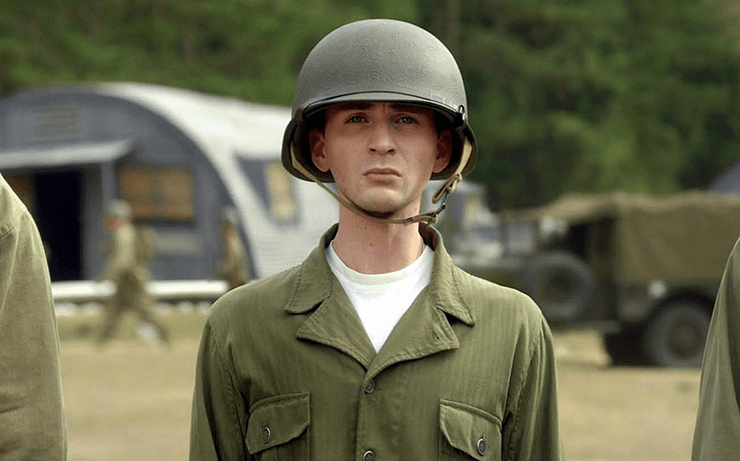
In Brooklyn, Steve Rogers is a short, skinny young man who keeps trying to enlist in the Army, but is rated 4F. He’s tried at several different recruitment centers, giving a different home town each time, and routinely rejected. He also is regularly bullied, refusing to back down but allowing himself to get beat up repeatedly and just getting back up. On the most recent occasion, he’s saved by James Buchanan “Bucky” Barnes, his best friend. Barnes has successfully enlisted, and is going to join the 107th as a sergeant. The night before he ships out, they go to a World’s Fair-type exhibition, where young Howard Stark demonstrates a prototype for a flying car (which doesn’t quite work). Rogers tries to enlist again, and this time his eagerness is noticed by Dr. Abraham Erskine.
Erskine is a German scientist who came to the U.S. after being drafted by Hydra to create a super soldier. His formula was used on Schmidt, and Erskine has brought it to America, working with the Strategic Scientific Reserve on Operation: Rebirth. The SSR, under Erskine, U.S. Army Colonel Chester Phillips, and MI-6 Agent Peggy Carter, are trying to create super-soldiers for the Allies. The other candidates to be the guinea pig are all able-bodied soldiers. Phillips is less sanguine about Rogers, and really only allowed him as a favor to Erskine. However, Rogers proves his intelligence and courage in due course. The former when he’s the first person in seventeen years to successfully bring down a flag from a pole. (Everyone else tries and fails to climb the pole. Rogers removes the pin and screw holding the pole up so it falls to the ground, and then he easily removes the flag.) The latter when Phillips throws a grenade into the midst of the soldiers, and everyone runs—except Rogers, who jumps on top of it, urging everyone else to get to safety.
Finally, Rogers is taken to a secret base in Brooklyn. Erskine has explained that he chose Rogers because the formula amplifies what’s already there. It made Schmidt from a bad person into an evil person, and he’s convinced it will take Rogers’s innate goodness and expand it.
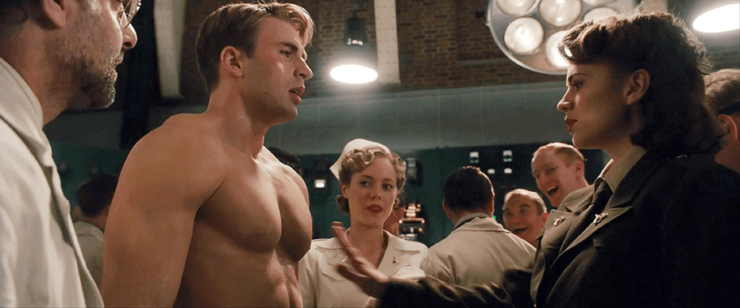
The experiment is a success, using Erskine’s formula and hardware provided by Stark. Rogers is now bigger and more muscular. (When Carter asks how he feels, he says, “Taller.”) Unfortunately, the representative from the State Department, who accompanied Senator Brandt, turns out to be a mole from Hydra. He shoots Erskine and dozens of other agents, steals the formula, and flees the scene. Rogers and Carter give chase. Carter takes out the assassin’s driver with a brilliant shot, but the assassin steals a cab and drives away. Rogers pursues on foot, eventually arriving at the Brooklyn Navy Yards, where the bad guy has a mini-submarine waiting for him. Rogers swims after him, ripping the cockpit open and bringing the saboteur to the surface. But he has a cyanide pill in a hollow tooth, which he swallows before he can be captured. His last words are, “Hail Hydra.”
Stark has never seen technology like the submarine. The SSR is going to the front lines to take the fight to Schmidt. Rogers isn’t going with them, however, as Phillips wanted an army and all he got was one soldier. He wants to send him to Alamogordo, but Brandt has another idea.
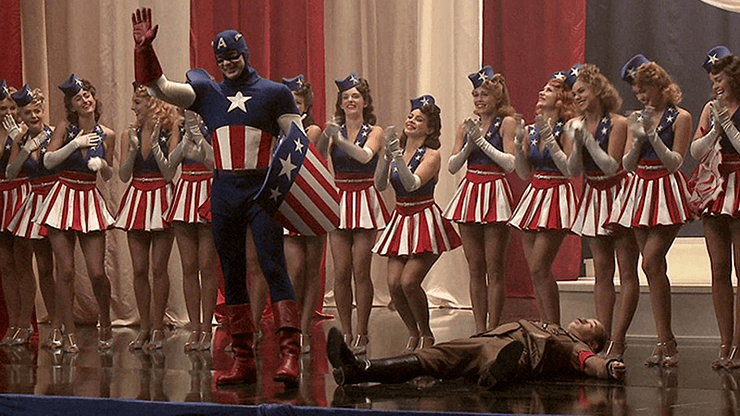
Rogers is put in a flag-themed costume, given a flag-themed shield, and he goes on a USO tour around the states, encouraging people to buy war bonds in the guise of “Captain America,” ending each show by socking an actor playing Hitler in the jaw. There are also propaganda movies starring Cap, comic books, and more.
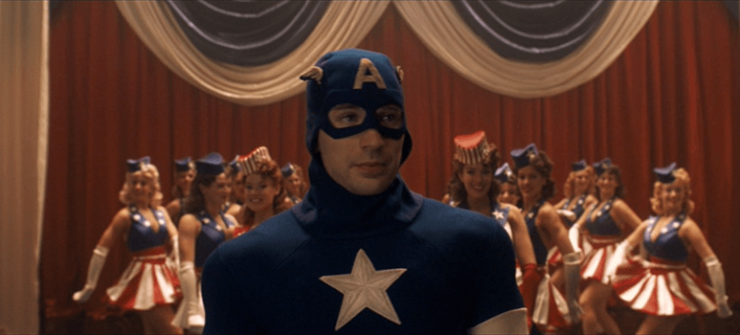
While the shows are a hit in the U.S., when Brandt sends him overseas, he’s less well received. The soldiers don’t want to hear from a guy in tights, they just want to see the dancing girls. Carter visits him between shows, and tells him that the soldiers he’s talking to are all that’s left of the 107th, which took on Hydra and got creamed. Rogers goes to a pissed-off Phillips asking if Barnes is one of the casualties. Phillips has no plans to mount a rescue of anyone Hydra has imprisoned, as they would lose more people than they’d save with an assault—and, Phillips adds, Rogers would know that if he wasn’t a chorus girl.
Encouraged by Carter, who like Erskine and Rogers himself believes that Rogers is meant for better things than being, well, a chorus girl, Rogers decides to mount a one-person rescue. Stark flies him behind enemy lines in his private plane, and Rogers manages to infiltrate the Hydra base, free a bunch of soldiers (including Sergeant Timothy “Dum Dum” Dugan), and grab a piece of technology that uses the Tesseract.
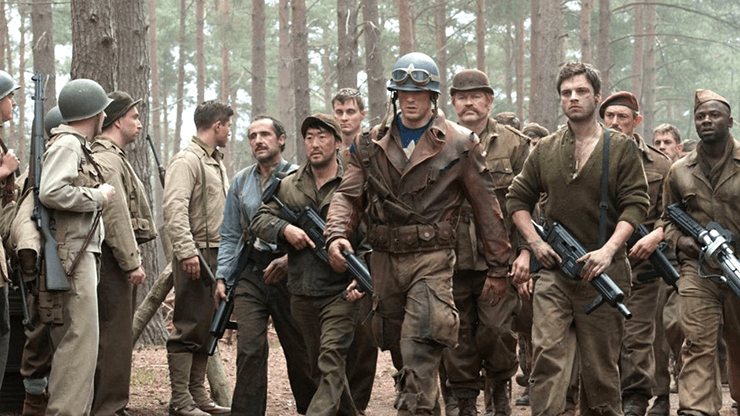
Upon seeing that Rogers and the freed soldiers are making short work of his people, Schmidt sets up the base’s self-destruct. Before he and Zola flee, they confront Rogers and Barnes (who was being experimented upon by Zola). Rogers discovers that Schmidt’s face is a mask covering a skull-like face and red skin, a side effect of Erskine’s earlier version of the formula.
Rogers and the various soldiers trudge back to camp. Phillips—who has already read Carter the riot act—is impressed despite himself. Rogers is given a medal, though he ducks out on the award ceremony (which is attended by a general who looks just like Stan Lee).
While freeing Barnes, Rogers saw a map that shows all of Hydra’s bases. Phillips agrees to let Rogers and a hand-picked team go after those bases. That team includes Dugan, Barnes, and many of the other soldiers he freed. Carter also flirts a bit with Rogers, who isn’t used to it. (He later is ambush-smooched by a female private, the sight of which doesn’t please Carter all that much.)
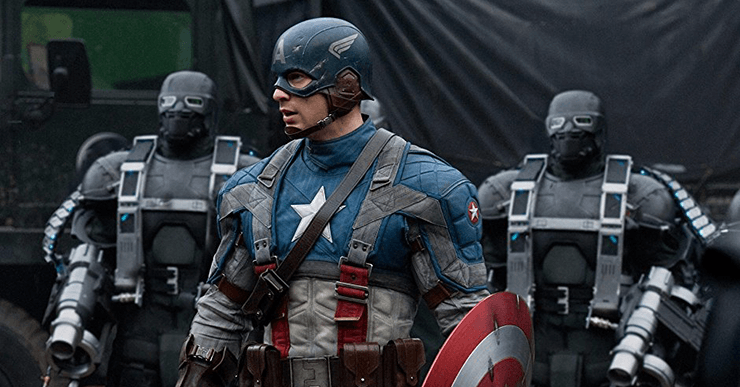
Stark provides Rogers with a better shield than the one he was using on stage, this made of vibranium, and a more practical version of his star-spangled outfit. Over the next several months, Rogers and his commando team make mincemeat out of Hydra. They go after a train that Zola is riding on, and manage to capture the scientist, though at the cost of Barnes’s life.
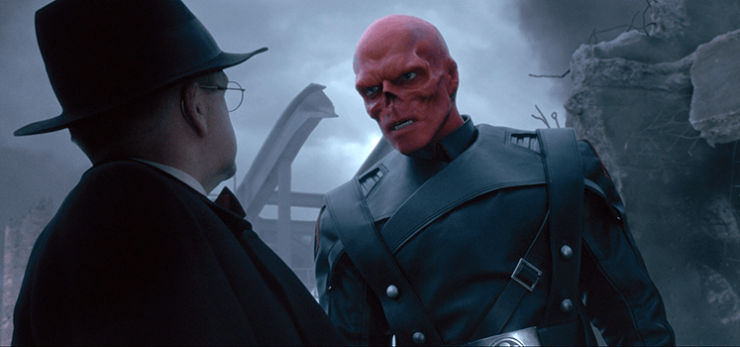
Phillips questions Zola, who is the first Hydra agent they’ve captured who didn’t swallow a cyanide pill. Zola explains that Schmidt has tremendous power at his disposal and he will display it first by wiping out several major U.S. cities. Zola reveals the location of the main Hydra base (which wasn’t on the map Rogers saw) from which he will launch his carrier.
Rogers goes in on a motorcycle with a frontal assault, letting himself get captured, which distracts Hydra long enough for the commandos to attack, backed up by Phillips, Carter, and a ton of soldiers. Schmidt takes off in the carrier, but Rogers is able to leap aboard the landing gear with help from Phillips and Carter (the latter gives him a kiss before he does so). He takes out the Hydra agents who were to fly the smaller craft to the cities to destroy them, and then gets into it with Schmidt. Rogers tosses Schmidt into the containment unit for the Tesseract, which shatters it, letting the object free. Schmidt makes the mistake of picking it up, and it displays a spacescape on the vessel’s roof and seemingly disintegrates him. (We’ll find out in Infinity War that it instead transported him to the planet Vormir.) Rogers can’t let the plane crash land in New York City, so he has to put it down in the Arctic where no one will get hurt. He stays in radio contact with Carter to the end, with them agreeing to go dancing the following Saturday.

Stark spends the next several years searching for Rogers, but finds only the Tesseract. (Which explains why S.H.I.E.L.D. had it in the post-credits sequence of Thor, and also what Stark and Ivan Vanko used as the basis of their ARC reactor design, as seen in Iron Man and Iron Man 2.) When the war ends, everyone celebrates, except for Carter, Dugan, and the commandos, who drink a toast to “the captain.”
In 2011, Rogers awakens to find himself in a hospital room, a baseball game on the radio. But it’s a game from 1941 that Rogers attended, so he knows the room is a fake. (For that matter, the alleged 1940s nurse has entirely the wrong hairstyle.) He breaks out and runs into the street, only to find himself surrounded by technology he’s never seen before. He’s confronted by Nick Fury, who tells him that he’s been asleep for seven decades. Rogers wistfully says that he had a date…
In the post-credits scene, Fury tells Rogers that he has a mission for him, and then we get a bunch of scenes from Avengers.
“He’s still skinny”
Aside from the whole Brooklyn thing, there is nothing about this movie that I don’t simply adore.
First of all, the script entirely gets Steve Rogers. All we knew about him when we first met him in 1940 was that he was 4F, a sickly young man who still wanted to serve his country. Over the years various folks (Stan Lee and Jack Kirby in the 1960s, Roger Stern and John Byrne in the 1980s, Fabian Nicieza and Kevin Maguire in the 1990s) added more and more to his backstory, establishing the crippling poverty he grew up in, but also that his parents (Irish immigrants) instilled a sense of patriotism and belief in the American dream in him.
The First Avenger doesn’t really deal with the poverty, instead focusing on Rogers’s physical infirmities and determination to stand up to bullies, whether it’s the jerk who won’t stop talking over the newsreels in the movie theatre or Adolf Hitler and Johann Schmidt. Evans absolutely sells this aspect of Rogers’s personality, which is especially impressive since he did the whole thing while green-screening and being computer manipulated into a tiny person and generally probably completely unable to interact properly with the other people on the screen with him. Yet the F/X never get in the way of the characterization, and Rogers comes across as completely honest and true.
And that’s only the beginning of the work Evans does, as he never loses sight of Captain America’s optimism, his intelligence, his compassion, his willingness to stand up for what’s right. In the wrong hands, Cap can be corny, he can be bland, he can be incompetent, he can be naïve, but when done right, he’s a human symbol, and both those words are important. In this movie (and subsequent ones), he’s very much done right, a credit to both the writing and the truly amazing acting that Evans does. He’s inspirational without being hackneyed, noble without being goofy, compassionate without being weak.
Evans is surrounded by a superlative cast, who all support Cap, but provide excellent characterizations beyond that. Stanley Tucci’s Erskine is a delight, full of so many nice touches—responding to Rogers’s query asking where his German-accented self is from with “Queens,” ruefully saying there’s less Schnapps left than there should be the morning of the test, and so on—but also a subdued passion that matches that of Rogers. Tommy Lee Jones is his usual amazing self, bringing an acid cynicism and snottiness that contrasts nicely with Rogers’s earnestness. (He also gets many of the film’s best lines, delivered with Jones’s expected perfection.) Hugo Weaving, for the second time in this rewatch, has portrayed an iconic comics character with far better talent than I’ve seen him evince in other genre roles (he was one of many reasons why I hated The Matrix, and his Elrond was dreadful). His Schmidt has a calm intelligence and a ruthless practicality that makes him incredibly scary. Sebastian Stan’s Barnes is a solid friend and comrade, his easy camaraderie with Evans’s Rogers showing a deep abiding friendship, a bond that will continue through several more movies. Dominic Cooper’s Stark is his son’s father, as the hints of the elder Stark’s seamier side that we saw in the “gag reel” Tony Stark watched in Iron Man 2 are in full force in the younger version. (Hilariously, Cooper’s Howard Stark is much closer to the 1960s version of Tony Stark than Robert Downey Jr.’s Tony was in his two movies.) Neal McDonough’s Dugan is perfect, and I deeply regret that we didn’t get a TV miniseries or a movie or something that was just Dugan, Carter, and the howling commandos continuing to fight the good fight in WWII after Cap stopped Hydra. (As it happens, my favorite episode of the great, underappreciated Agent Carter series is the one McDonough guest stars in as Dugan.) The rest of the Howling Commandos don’t get much to do, but create interesting characters in a very short amount of screen time. (My favorite is Kenneth Choi’s Jim Morita, who whips out his dogtags with practiced frustration when Dugan questions his being freed with the others with a cranky, “I’m from Fresno, ace.”)
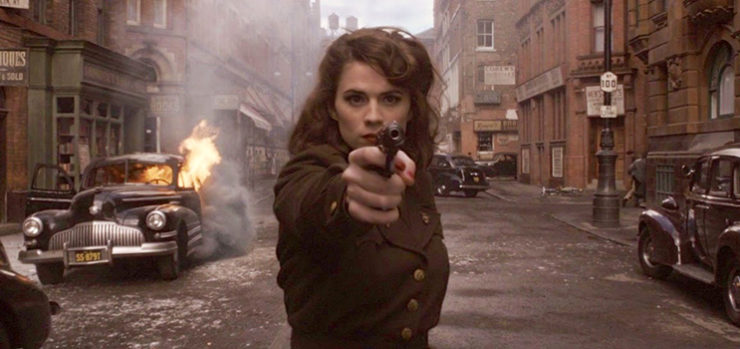
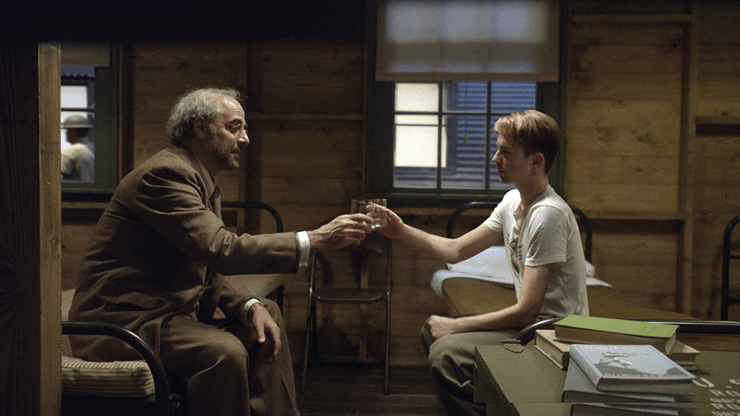
And then we have what may be the single greatest character in the entire Marvel Cinematic Universe, Hayley Atwell’s superlative Agent Peggy Carter. A role that could easily have just been the generic female lead is instead a strong, worthy character. As a woman struggling to succeed in a male-dominated field, she understands Rogers’s struggles trying to fight the good fight while being restricted, though in his case the restriction is physical rather than sociological. In particular, I like the fact that Carter very obviously starts to fall for Rogers before the experiment—what impresses her is the intelligence, the fortitude, the willingness to do whatever is necessary to do what’s right. And when all hell breaks loose after the experiment, Carter is the one who reacts the fastest, even taking out one of the saboteurs with a perfectly placed head shot. And in the end, she’s right there with Phillips and the rest storming Hydra’s base. Atwell will continue to shine, showing up in a one-shot, briefly in the next Cap movie and in Ant-Man, on an episode of Agents of S.H.I.E.L.D., and her funeral is a pivotal scene in Civil War, but it’s on her own tragically short-lived TV show that she has truly proven herself as the rock star of the MCU, and it’s a pity that it didn’t get the ratings it deserved.
The greatest performances in the world will only go so far if the script sucks, but luckily that’s not a problem. This is a prototypical war story, hitting all the beats, but doing so with characters we care about. In fact, the biggest problem with this movie is that, for all that it so completely embraces the trappings of the era (the technology—even that powered by the Tesseract—is still very much mid-20th-century tech, the hairstyles and fashions are completely of the era, the streets of Brooklyn are less refined as befits the time, and Cap’s USO show is 1940s perfection, with “The Star-Spangled Man” a magnificent riff on the music of the period), it isn’t really a World War II movie. I mean, it kind of is, particularly in the early going, but as it progresses, it becomes the SSR (which we’ll later learn is the forerunner to S.H.I.E.L.D.) against Hydra, with the greater war barely acknowledged. Hell, but for the existence of Choi’s Morita, there’s no evidence of a Pacific theatre at all. And I find it impossible to credit that Schmidt was able to continue to function with impunity after disintegrating three of Hitler’s people, an action that is unconvincingly consequence-free for him. Both the Red Skull and Hydra have always been portrayed as an integral part of the Nazi infrastructure, and to have them separate like this is a bit odd. I also think the two-armed salute is a little ridiculous. I can see the story meeting now: “It’s just like the Nazi salute only with both arms so it’s twice as evil!!!!”
Still and all, just as Thor provided an MCU movie that showed it could move beyond the confines of scientists experimenting with things and into more fantastical realms (and also manage without Tony Stark), Captain America: The First Avenger gives the MCU some of the history of superheroing that Nick Fury hinted at in the Iron Man post-credits scene, some of it directly related to what we’ve already seen (the Tesseract, the SSR becoming S.H.I.E.L.D., the background of the experiments on Bruce Banner and Emil Blonsky that tried to re-create Erskine’s formula, etc.). And even without all that texture, it’s a ripping yarn, a rollicking good adventure with great action scenes, superlative characterization, and all of it revolving around a magnificent performance by the lead.
Next week, it all comes together, as we bring Iron Man, the Hulk, Thor, Captain America, and S.H.I.E.L.D. together to face Loki (among others) in Avengers.
Keith R.A. DeCandido knows he’s irrational about the whole Brooklyn thing, but the last straw was when they put up a damn statue. That statue should be on the Lower East Side, dammit.



The “War to End All Wars” was WW1, NOT WW2
I’ve loved how in ‘Incredible Hulk’, we see the knock-off formula start to change Blonsky’s physical appearance as it brings his evilness out (he starts to get his spines before he gets Bruce’s blood), and then we see another recipient of the Super Soldier serum get a physical change to reflect their evilness (Red Skull). I always thought that was a nice touch.
Also, ‘Ryan Krasinski’ should be ‘John Krasinski’.
Maybe it’s because I’m not an American, but are most people really able to distinguish between Brooklyn and the Lower East Side? To me it’s all just generic New York.
One thing I’ve always wondered about Captain America is why Cap v. Commies doesn’t seem to work that well. It seems like a slam dunk, having a clear enemy to the United States and attacks on human rights and dignity. Maybe because the Cold War was more about spycraft and MAD than straight up battles?
I was originally pretty skeptical that Evans (who I liked as the Human Torch) would make a good Captain America, but boy did he prove me wrong. In his MCU work he just exudes integrity all over the screen.
Yes you can, just look for the most popular streets and you might fund where it is.
@1, if you read the first sentence again, you’ll see that it says, “war after the War to End All Wars” which was indeed World War II. It tripped me up for a second, as well. I have a tendency to read too fast, its a good reminder to slow down and pay attention.
3. vinsentient I’m from southeastern Wisconsin (about a 900ish miles from New York) and I can’t tell the difference. But KRAD is a native, so…
Minor spelling: Johann Schmidt.
Otherwise, great column which highlights a very well done movie. Yet, it seems at times this movie gets lost in the shuffle in comparison to Winter Soldier, which raises the bar even higher.
Love the movie love this essay on it. Thanks! It’s funny. Cap is by no means my favorite Marvel character in the comics but he’s one of my favorites in the MCU to be sure.
One factoid I learned: The guy who plays the “skinny Steve” body in the first part of the film shows up when Cap and the Howling commandos are in that bar. He’s the bartender.
Thanks again.
Man, I love this movie. I had some initial concerns, mostly because as I mentioned in previous recaps, the MCU’s Tony Stark seems to draw a lot from the Ultimate version of the character, and the last thing I wanted to see on-screen was the Ultimate version of Cap. This movie is the one where Marvel proved that they had the confidence to embrace the whole of their characters’ histories, and pick the best parts to make a movie out of.
Evans’ contribution to the MCU as a whole simply can’t be understated. If RDJ’s performance is the one that allowed the MCU to exist at all, Evans’ is the one that makes the whole connected universe work. He takes a complete straight-arrow of a character, who could easily be boring or foolish, and makes him into someone determined and inspirational — the leader that the Avengers need for the stories to function.
I’m going to have to rewatch this one. I enjoyed it, but it’s one of my least favorites. Thanks for the write up!
I didn’t see this one in the theater — don’t remember why not, but it was a very poor decision on my part. I rewatched it earlier this week and it’s definitely in the top tier of MCU movies.
My one niggle is the whole making Steve Rogers a chorus girl bit — yes, there’s just the one of him, but after seeing his performance chasing down the HYDRA agent, I’d think they would’ve found a better use for him; if they want somebody to wear a costume on stage, there’s no reason for him to be the actual Super Soldier (except for the bit where he holds the motorcycle over his head). But I’m willing to concede it because it provides a good explanation for the costume.
So I’m guessing that the shield Tony used in IM2 to prop up the particle accelerator tube must’ve been some kind of failed pre-vibranium prototype?
This is easily my favorite of the Phase One films in the Marvel Cinematic Universe. Nearly everything is pitch-perfect. In particular, the score by Alan Silvestri is top-notch, with the moment Rogers marches the POWs back to camp a particularly heart-swelling bit of composition.
I have to say that Phase One of the MCU has some of the best music going for this type of film. From Ramin Dawadi’s Tom Morello-assisted orchestra-meets-metal crunch in the first Iron Man to Patrick Doyle’s appropriately Wagnerian stuff in Thor, to the all-out themes Silvestri pulls off in both this and the Avengers, there’s no shortage of great stuff. One of the areas Phase 2 fell short for me was that, other than Brian Tyler’s Iron Man 3 score, there was nothing that grabbed my attention like the first bunch of scores. Phase 3 has been somewhat of an improvement – particularly with Silvestri back and with the great score Ludwig Goransson did for Black Panther.
Additional credits: The “Skinny Steve” body double that Evans’s head was superimposed on was Leander Deeny. Basically it was a joint performance by the two of them. And the female private who snuck a kiss with Cap was Natalie Dormer.
I agree, this is a nearly perfect movie, really well-done. Stanley Tucci was a particular standout for me. And Alan Silvestri finally gave us an MCU score with a real, hummable theme for the hero, a theme that’s continued to be used ever since, unlike most prior and subsequent MCU movies.
What bugs me slightly, in the context of authenticity, is that the “classic” Cap costume was rendered as crude cloth and the “battle suit” version was high-tech polymer and leather. In the comics, Cap’s WWII-era costume was made of scale mail, not cloth. It would’ve been interesting to see them replicate that in live-action. (I’ve seen photos showing that Cap’s Avengers 4 costume will have a “scale mail” texture, but it’s just decorative surface molding.)
@1 And before WW1 it was the Crimean Campaign, and before that it was the Napoleonic Wars, and before that…. We’re had a lot of war to end all wars, almost like fighting a war to stop war just doesn’t work.
As a quick aside, none other than Jenna Coleman (“Clara Oswald” from “Doctor Who”) is in the film, portraying Connie.
I liked all the little touches we get in the background. When Steve Rogers is chasing the Hydra guy, Steve uses a taxi cab door as a shield. The cab company is the Lucky Star Cab Company and their logo is a star.
12. ChristopherLBennett Don’t forget that Richard Armitage (Thorin Oakenshield) played ‘Heinz Kruger’ (the Hydra agent who shot Erskine).
@6 Thanks for the catch! Annoyingly, Redskull’s name is spelled Shmidt in the comics, and Schmidt in the MCU film.
Man I love this movie. For me, the best films have great “moments.” In this one one of my favorites was when Erskine said “People often forget the first country the Nazi’s invaded was their own.” That was such an amazing quote. The other was the amazing USO shows. I was feeling a bit tepid about the film at that point, but when the shows started I was really in love. Talk about hitting the nail on the head. Kudos Johnston and company.
My one big compliant about it was also my favorite part. When they got to the montage of Cap and the commandos tearing Hydra apart, I sat up in my seat thinking this was what what I came here for. Yeah! Then it stopped too soon. Awwww! I get what the story was going for, but I really could not get enough of that.
The first of the Marvel Studios films I really loved. Just so much heart and charm.
One thing that had to be pointed out to me is that, in the exhibition sequence, you can see in the background the original Human Torch encased in glass.
Damn, missed opportunity, Marvel.
Did anybody else have an issue with Agent Carter using her position of power to punch that defenseless soldier and then, later, shooting at Captain America? Like, how are these things acceptable?
18) I wish they could of made a companion/short movie of Cap & the commandos taking on Hydra for maybe a definitive edition on bluray. This movie is also for anyone who loved Johnston’s The Rocketeer.
Manchester, England doubled as Brooklyn for many of the street scenes. The buildings are reminiscent of 40s Brooklyn, so they dressed them with fake shop fronts, filled the streets with classic American cars and CG’d distant backgrounds down the alleys, including the Bridge. My dad was there during filming and took loads of BTS photos (which he has since misplaced, much to his annoyance). Every time we watch it he has to say “I was there” and “I saw them doing that” during those scenes.
@20: I didn’t have any problem with her hitting the soldier because he was being a sexist dick. The shooting at Steve thing, though, did come across as pretty iffy, especially since Steve really didn’t want that kiss.
@3, @5 – putting aside that being able to tell the difference visually, there is a lot of narrative about what borough of NY someone grew up in and when. Kirby was from the Lower East Side, and Brooklyn was where his parents were running from when they moved there, and he was very much defined by rivalry between Jewish and Irish gangs, and wrote a lot of that violence into the comics. It’s a stupid thing to get wrong.
Besides, there are almost as many people in New York City as are in Minnesota and Wisconsin *combined*, so it’s like making a movie about the Green Bay Packers, but replacing them with the Vikings and saying that “all those flyover states look the same.” I don’t care for sports, and I think regionalism is dumb, but if you confuse the two Carolinas I will be VERY UPSET.
My favorite part were the credits and the music, which captured the era perfectly. The WWII propaganda poster styles really reinforced that this was set in a different time where heroes did things because “I hate bullies.”
Todd: as Lady Gayle said, read the sentence again. I called WWII the war after the War to End All Wars. It was sarcasm, of a sort.
David: as Sarah said, I got the comics and movie spellings mixed up. Blame me for re-reading Captain America #298 after watching the movie.
Austin: I had no issue with Carter slugging Hodge, but you’re right, firing the gun at him was incredibly irresponsible.
—Keith R.A. DeCandido
My favorite easter egg in this movie (and really all of the MCU) is when Steve and Bucky go to the fair and walk past a giant glass tube housing none other than the original Human Torch.
I forgot to cite the Stan Lee cameo, so the plot description has been updated accordingly with a mention of the medal ceremony that Rogers ducks out on.
Also in general: yes, there’s a big difference between the Lower East Side and Brooklyn, for a number of reasons, though the ones given by Erik in comment #24 are the biggest.
—Keith R.A. DeCandido
Another bit of Phase One continuity: The “World’s Fair” here was actually a Stark Expo, a forerunner of the one featured in Iron Man 2. And the flying car that Howard demonstrated was presumably using a prototype of Tony Stark’s repulsor technology (and was no doubt an ancestor of Lola, Coulson’s flying car in Agents of SHIELD).
vinsentient @3: Echoing Jason_UmmaMacabre @5, I live in San Diego, which is just about as far away from NY as you can get in the continental US, and while intellectually I understand there’s a difference, emotionally it just doesn’t matter to me. But I can completely understand how a native New Yorker would see it differently.
Not an outstanding film, but a great first outing for Cap in the MCU, with a convincing lead, nice action, and a pretty accurate costume. My only issue with this film is that Cap doesn’t get to do much shield-slinging or acrobatic fighting. All that was corrected in Avengers, and then Winter Soldier is probably my favorite MCU film. I would like to see Joe Johnston do another Cap film.
It also gave us Peggy Carter and the Howling Commandos, I remember seeing Dum Dum Duggan in the trailer and squeeing loudly. And the way they wrote in Bucky, getting rid of the child soldier bit, but still giving uss his friendship and setting up the Winter Soldier, that was great.
@krad: Commie Smasher cap, aka William Burnside was later revealed to have been placed in suspended animation, and is now the super villain known as The Grand Director. (BTW, you wrote “Almogordo” instead of “Alamorgordo”
I do agree about the unnecessary and insulting change of Steve’s neighborhood to Brooklyn (and not just because I was born in the Lower East Side :>).
@15 – ragnarredbeard: The cab door with a star bit was cute.
@18 – cleggster: I needed more of the stuff in that montage, too.
I went into this movie with a great deal of trepidation. Cap has been my favorite super-hero since I started reading his comics in the mid-1960s, and I was worried that the movie might not do him justice. After seeing Chris Evans in the lackluster Fantastic Four movie, I wasn’t sure how he would do portraying Cap. And I was very worried that they would lean too far into the Ultimates universe, and make a Cap that was less heroic than the original.
But within a few minutes, I was hooked. They got the best things about the character absolutely right: the fact that his courage and decency was what made him special, not just the super strength. The special effects that made Steve skinny were superb, and worked perfectly, with Chris Evans being pitch-perfect in the role. The new version of Bucky worked even better than the improbable teenaged version from the original comics. Tucci and Tommy Lee Jones were great. The script and the great work of Hayley Atwell took a fairly colorless love interest from the comics and turned her into an excellent character in her own right. Hugo Weaving was an excellent Red Skull, and Toby Jones an excellent Zola. And the Howling Commandoes were not quite what I had remembered, but good anyhow. The story moved right along, and kept me riveted. Even though the USO storyline was a bit improbable, it was great to see the classic suit, and then see Cap throw off the limits of that assigned role, and become the super-soldier that had been intended. I walked out of the movie on Cloud Nine, delighted that they had done justice to my favorite character.
I only have two things I would have changed. The attempt to separate Hydra from the Nazis, and have them be fighting each other as the war progressed, just didn’t work. And I would have ended the movie right after the scene that showed the young boys in New York playing at being Cap, saving the rebirth in modern days for a post-credits scene. But those are quibbles, and this is my second-favorite MCU movie (with the sequel, The Winter Soldier, being my favorite).
@31/MaGnUs: It’s Alamogordo. Keith left a letter out, you put an extra one in.
I was very surprised at Bucky’s “death,” because I really didn’t know where they were going with the character, since he was quite different from the sidekick character I’m familiar with. I was especially surprised that they seemed to be setting up the Winter Soldier story for a sequel. That story was only a few years old in the comics (published in 2005-2006, and the movie came out in 2011), so I didn’t think they’d mine something so recent. Plus, as a long-time comics fan, I was still trying to deal with the idea of Bucky being back at all, since all young comics fans knew that the list of “characters who can never be resurrected” includes Uncle Ben, Thomas & Martha Wayne, and Bucky.
@33 – Chris: Oops… Yeah, I know, I made another typo while correcting Keith’s. J
The article said that in the comics the Red Skull’s visage is a mask over an ordinary face. That is not entirely correct. Depending on the writers and the era, the Red Skull’s face has veered back and forth between being a mask or a disfigurement of some type. And at one point, his face was the same as Steve Rogers’, as he inhabited a cloned version of Steve’s body.
Also, I had the honor of meeting Joe Simon a few years before his death. They had just made Bucky into Cap in the comics, and had him carrying a gun. Simon hated that idea, and I expect he would not have liked the scenes where WWII Cap carried a sidearm. He also said that one day, after they were told that some Nazi sympathizers were marching outside the Timely building in protest of that comic where Cap punched Hitler, Kirby rolled up his sleeves, intending to go out and pick a fight with them. They convinced him not to go down to the street, and Simon said that was good fortune for the marchers, as Kirby was quite a fighter.
On Brooklyn… Not being the Lower East Side. To everyone not a fan of the comics, or from in/around NEW York City, Brooklyn is well know and common to New York. It is established enough to know were it is to the rest of the world without having to say New York city.
Basically they made the change for 95% of the audience. With how much We NEED to relate to Steve for this movie to work. Basically it may seem small, but to the 95% of the audience it was one less thing they needed to believe in Steve.
@36 – Alan: I read another story that some Nazis walked into the building and asked for Kirby to meet them downstairs. When Kirby got downstairs, sleeves rolled-up, they were gone.
@37 – Kasiki: The audience would already know he’s from New York, and buy that. It adds nothing to make him from Brooklyn.
An enjoyable movie. It’s too bad Joe Johnston didn’t work in a Cliff Secord/Rocketeer cameo or reference while the team was fighting the good fight, but the sequence aboard the flying wing was enough like the zeppelin fight to seem like a spiritual Rocketeer sequel, I guess.
And speaking of flying wing, that was a nice Raiders of the Lost Ark reference at the beginning when Schmidt mentions Hitler looking for artifacts in the desert. Now if only we could see Rogers, Secord and Jones punching Nazis together, haha, that would be something.
@8: I think the saying is something like: if RDJ’s Tony Stark is the heart of the MCU, then Evans’ Steve Rogers is its soul.
38. MaGnUs I think it means something that he never says he is from NYC… It is always Brooklyn.
As far as the rest of the world is concerned, the are 5 boroughs, But Manhattan, The Bronx, Queens and Brooklyn are all anyone will readily recognize. (I had to look up that the Lower East Side wasn’t one). Lower East Side can apply to any one of a hundred cities, Brooklyn applies to one.
There is a difference in a character saying he is from New York and a character saying he is from Brooklyn. My guess is they had to upgrade to a borough to get that feel and, thanks to the Dodgers, Brooklyn was chosen.
@13 – I’ve never heard of anyone ever claiming Crimea would be the war to end all wars. After all, it was a pretty small-scale and unimportant imperial kerfuffle, especially in comparison to the Napoleonic Wars or the World Wars.
This was actually my least favorite MCU movie, mostly because I found myself unable to turn the historian part of my brain off and comparing the on-screen war to the real war kept taking me out of the movie. I know it’s silly to expect the history of the MCU to be any more like our history than its present day is like our present day, but I couldn’t help it bothering me. It seemed especially off how Tommy Lee Jones was basically running the whole war on his own.
However, I absolutely love Chris Evans’ Cap, for the all the reasons Keith and others pointed out. Somehow, he manages to slide past all my cynicism to the disappointed idealist underneath. He’s absolutely my favorite part of the MCU.
Not much to add to what’s already been said (numerous times) in the article and the comments, but yeah. Wonderful movie with even more wonderful acting. Unlike so many, I knew absolutely nothing of Cap prior to seeing this, and I was actually quite confused about the title, not understanding what the “First Avenger” was supposed to mean. But when I saw it … I was so hooked. I loved everything about it, from the portrayal of the era to Steve’s wonderful personality (“I figured I’d wait.” “For what?” “For the right partner.”, and the scene with the dummy grenade just melt my heart) to his friendship with Bucky (to whom I ALSO have a really soft spot) to all the other brilliant roles (“I’m not kissing you!”) to all the little touches like the taxi door ragnarredbeard @15 mentioned …
It just occurred to me I should probably apologize in advance, because I’ll probably be professing my undying love with all the following MCU movies as well. At least I warned.
And I think ambush-smooch is now my word-of-the-week.
SaltManZ: I actually said that in my rewatch of Fantastic Four. :)
MaGnUs and Christopher: Thank you for catching my Alamogordo typo. ‘Tis fixed.
kasiki: I disagree with you 100% that he “needs” to be from Brooklyn to be more relatable.
—Keith R.A. DeCandido
#41
Bingo. And the word Brooklyn arguably has more punch than Lower East Side. I’m guessing they changed it for the line: “I’m just a kid from Brooklyn.”
On the Lower East Side/Brooklyn question: remember that New York City, as we think of it, with “the five boroughs,” was only incorporated in 1898. In the lifetime of many folks alive in the 1940s, Manhattan and Brooklyn were each separate cities over 250 years old.
I agree with everyone here that this movie was fabulous (although I don’t rewatch it as often as The Winter Soldier, which remains my favorite MCU film). As a guy who was myself previously rejected on multiple occasions for military service for health reasons and had just gotten into good shape by the time of the film’s release, one can guess who I dressed up as for Halloween that year (the impromptu outfit from the rescue scene, with the helmet and leather jacket)
Nice review, and a well done film.
One minor (historical) bit: The “107th” referenced in the film has the same number as the historical 107th Infantry Regiment of the US Army, which – in reality – was one of the National Army units mobilized for the AEF in WW I (the “war to end all wars,” as noted above), based initially on cadre from the NY National Guard’s 7th New York Infantry. The 7th has a history that goes back to early in the 1800s, including repeated service in the Civil War. As a state unit, the 7th recruited (historically) from Manhattan (New York County), which works for the “Lower East Side” but was (generally) nicknamed the “Silk Stalking Regiment” because it recruited largely among the Protestant, WASP ascendency types, the Knickerbockers where families like the Roosevelts (before Oyster Bay) would have been found – which doesn’t work for the Lower East Side, of course.
By 1917, the recruiting pool was different than it had been in the 1800s. The regiment served in France during WW I, suffering roughly 70 percent casualties, and remained on the rolls as such until 1940, when it was converted to a anti-aircraft unit and saw service as such in WW II.
The 107th Regiment Memorial in Central Park is quite impressive; in some ways, something of a precursor design to the Three Soldiers statue that is an element of the Vietnam War Memorial.
Great movie, I totally agree! I’ve started making this a regular 4th of July watch every year. The one complaint I have about the movie is the pacing. It nails the origin story, then introduces the Howling Commandos, the we get a long montage so we can skip to the end of the war and Cap’s final battle before getting frozen. I just wish they hadn’t skipped through his WWII career so much. I understand why they had to do it, but it’s disappointing (in the same way that the year of “no man’s land” is just skipped over in The Dark Knight Rises) sometimes I wish these movies could be miniseries’ instead of movies.
My one quibble with the film is that once we get done with the Hitler-punching, it’s a pretty fascist-free film, in that the Red Skull becomes more of a generic madman than the Nazi’s Nazi that he is in the comics. Having him turn on Hitler – though accurate to the comics, makes for a slightly odd turn. Are we expected to believe that the Skull is somehow worse than the Nazis due to his betrayal? Did they think it somehow diminished his villainy to have him subservient to Hitler? The cynic in me wonders if it wasn’t done to avoid alienating a chunk of the European moviegoing market at a time when selling a character named “Captain America” was already thought to be a bit difficult …
@38 If you got your info from a written source, it is probably more accurate than an old guy remembering what another old guy told him many years ago. The key take-away is that Kirby was the kind of guy who was willing to roll up his sleeves and wade into a fight for something he believed in. Cap’s idealism had its roots in the bravery of real people.
@50: No, I’ve heard both anecdotes, and they’re referring to two different incidents where he was about to go smashing some Nazi faces. Kirby was always up for punching Nazis, basically.
And, good news, Keith gets to hear about it (and most likely talk about it) again, the Brooklyn thing, when he gets to “Captain America: Civil War”! (The part where Cap meets Spider-Man.) :-)
@20, 23: I think it was perfectly responsible for Agent Carter to shoot mere bullets at a vibranium shield held by a man with inhumanly fast reflexes. She had surely seen similar experiments and knew perfectly well the bullets would drop harmlessly.
I’m assuming a fact not in evidence, true; I’m not assuming a violation of character, though, and that trumps lack of evidence.
@37 I think you hit the nail on the head. To anyone outside of New York, Brooklyn is one of the only suburbs people have heard of. Lower east side wouldn’t connote to New York to anyone outside that city. Rather than being miffed over which suburb he is from, I would think New Yorkers would be more upset by being represented by someone as selfless, kind, and nice as cap is supposed to be.
As for the movie, I have to agree with the minority opinion. Evans is good as usual, but the character is still bland.
Any fans of Chris Evan’s PUSH here. I am one of the few that enjoyed it. The HK locale gives a strong vibe to it.
@55/felix77: I agree, Push is a terrific, underappreciated film that makes fantastic use of its Hong Kong location. It builds a whole rich superhero(ish) universe that I would’ve loved to see developed in further films, or in a TV series.
@53, I agree with you. Peggy knew that the vibranium shield would react as it did.but I think that the was a slight twist to her smile at that moment, a bit of a pay attention there, to Steve, at that moment.
I love the movie, but really dislike the rookie mistake of the baseball game recording. The SSR knew when they lost Steve, therefore SHIELD would have that information available. there are many possible recorded games that are available to use. It just feels like the writers ignored plausibility to give Steve a manufactured “Got You” moment . I’d have liked a different way.
@2 is correct. It should be John not Ryan.
@57, About the ‘wrong’ baseball game, there’s a good fan theory saying that all of that was a test. As Keith pointed out, the hairstyle was all wrong, the baseball game was wrong, but also the tie was the wrong width and the outline of the bra showing through her shirt – it’s the wrong type of bra for the 40s, it’s the wrong size, etc. It’s all a test to see if Cap is smart, if he came out of the ice with his faculties intact, to see how he reacts to this, how long it takes him to get his bearings, and so on. Fury set it up so he could get a good look at who Captain America was now, not the man in the 70 year old files. And how better to see someone’s character than put them under pressure in some way?
(57 should have also been Wrenn…. I misstyped on my phone).
@59 Yeah. Most people don’t realize her hair was wrong. (1) She’s in a uniform, her hair wouldn’t be down past her shoulders 2) it’s too soft. bangs over her forehead on the right— everyone who could had victory curls during the war.)— I told Keith the hair was wrong last night. (For a movie with few miss-steps it’s noticeable)
The fan theory is too pat, it looks too much like a ret-con to me. As for it being ‘a test’, that doesn’t jive with Fury’s words – about “we thought it best to break it to you slowly”. Shield wouldn’t have exposed the public like that- in Times Square. (which I think is only used for the movie audiences sake, because it’s so iconic, present day. ) There would have been more than 2 agents waiting outside. It would have been an all hands thing.
Also, if it’s a test, it’s pretty ham handed. To be queued up right at the most memorable part of the game when he wakes.
The May 24th 1941 game is memorable for the Reisler’s inside the park grand slam in the 6th inning.
(And then there’s addressing converging 7 black SUVs and sedans in Times Square, in the middle of the day, where 3 of them are going the wrong way on a one way street….)
@49/Twels:
Bingo. It’s important to remember how much of a risk this film was considered in international markets. The studio was very worried that America’s essentially unilateral invasion of Iraq, and the insults the Bush administration lobbed at traditional allies who wouldn’t play along, had all but eliminated potential interest in a movie that might show the upside of U.S. military intervention abroad (and which had the name “America” right there in the title). Marvel even gave foreign territories the option of truncating the film’s title to simply “The First Avenger” to avoid turning off audiences, but only three of those territories took advantage of the offer: Russia, Ukraine and South Korea.
Some advance promotional materials even stressed that Cap would be depicted as merely one member of an international cadre of freedom fighters. In that sense, it’s probably fortunate we didn’t end up seeing more of the Howling Commandos, if it would have meant diminishing the lead character’s prominence within his own movie. But as you pointed out, some softening of the material is evident in the final cut, with the enhanced independence of the Red Skull apparently meant to downplay Cap’s adversarial relationship with any particular country. At times, it seems like World War II itself is merely a background to the story’s central conflict.
Still, it’s a great picture. And given the time and the sociopolitical context, it’s almost a wonder the thing got made at all. Imagine how hard a sell it might be now, with Washington’s stance regarding the rest of the world more antagonistic than we could have foreseen even in the seemingly fractious days of seven years ago.
On the subject of downplaying the Nazis, I was amused at how rare swastikas are in this movie. Red Skull replaces them with the Hydra symbol, the actual Nazis visiting him have their armbands turned around to hide it, and so on. The only time we see one is on the fake Hitler in the show.
As Keith pointed out in the Fantastic Four review, Ben Grimm was given the same change from the Lower East Side to Brooklyn. It makes a little more sense there because he’s a contemporary character and the real-world Lower East Side is so gentrified now. The real equivalent of Ben’s Yancy Street has a building with two-million-dollar condominiums. Whatta revoltin’ development. Of course this doesn’t work at all for Steve Rogers back in the 1940s.
Yes, the lack of Nazis in this movie is a bit odd. A few shots of Cap fighting real fascists among the faceless Hydra goons during the big montage would’ve been welcome. But at least Hydra is still shown to be extremely fascist, what with their salute and all. They’re double evil! More extreme than the Nazis it seems.
I really enjoyed Weaving as Red Skull. Though I seem to remember reading somewhere he hated wearing the makeup and isn’t interested in returning to the role. A pity.
Hmm.
I do pretty much agree entirely with the review, but it has always felt like this film, more than any other, is largely box-ticking to get everything in place for The Avengers. So, show Captain America getting his powers during World War II, show him having some adventures there and then freeze him into suspended animation so he can show up in the present day. Establish Bucky Barnes as his wartime friend then have him die in an ambigious way so he can also show up in the present day in the sequel. It feels a bit like the ending is too pre-determined.
That said, it’s a good adventure romp if not too deep, Steve Evans is indeed pitch-perfect as the noble and innocent Captain America, and we get a decent portrayal of Red Skull. So still worth watching.
Long-time lurker, first time poster signing in to say that this is the film that a) made me a Cap fan and b) got me into the MCU and I have a big grin on my face seeing all the love for it.
One thing I don’t think anyone’s mentioned is that Steve and Peggy’s final conversation over the radio is a blatant and loving homage to David Niven and Kim Hunter in Powell & Pressburger’s A Matter Of Life And Death (aka Stairway To Heaven). In fact not just an homage but a complete mirror image of it – climax of the film rather than the beginning, US pilot and British radio operator, Steve and Peggy know each other well while Peter and June are only just meeting…and unlike Peter and June they don’t get a happy ending (*sniffle*).
Re: Evans’ performance, I don’t think he’s ever given enough credit for his body language as Steve. In on set photos you can tell in an instant if he’s in character because as Steve he always stands that little bit straighter etc. Even the way he hands Fury that ten bucks on the helicarrier in Avengers looks like he practiced it for hours after binge watching Gary Cooper films.
@62/Gareth: I think the avoidance of Nazi iconography had to do with merchandising and toy sales — selling products emblazoned with hate-group emblems as fun toys for children is kind of a problematical thing to do. And I believe the display/marketing of Nazi symbols is illegal in Germany, so they had to be avoided to make the film and tie-in products marketable there. This has also affected other superhero productions before this, like the animated Justice League 3-parter set in an alternate WWII where Vandal Savage had kicked out Hitler and replaced the swastikas with his own emblem.
@64/cap-mjb: I agree it’s evident that this film is designed to set up The Avengers — heck, they admit as much in the subtitle — but that’s what’s so impressive about it, that it works so well as its own entity despite that. A number of superhero/genre films have failed as self-contained works because the filmmakers were too distracted with setting up future films — Green Lantern, The Amazing Spider-Man 2, the Tom Cruise The Mummy — but this one managed to pull off both at the same time. Perhaps that’s because all the other Avengers characters and elements had already been seeded in earlier films rather than needing to be set up all at once in this one, so it was free to focus on just Cap’s story.
Couldn’t they have just changed the symbol in the toys themselves and not the film? If you’re gonna have a film about world War 2 on the Frontlines, you can’t just avoid showing what was being fought. Especially now today there are genuine neo-nazi movements mobilizing. I agree with some of the commenters above. Not showing them is an act of cowardice, at least for this film specifically.
Quoth Stormy: “To anyone outside of New York, Brooklyn is one of the only suburbs people have heard of. Lower east side wouldn’t connote to New York to anyone outside that city. Rather than being miffed over which suburb he is from, I would think New Yorkers would be more upset by being represented by someone as selfless, kind, and nice as cap is supposed to be.”
Okay, first of all, Brooklyn isn’t a “suburb” of New York City, it’s part of New York City. Contrary to popular myth, New York City isn’t just the part of Manhattan that’s between Harlem and the Battery, it’s five boroughs, of which Brooklyn is one (and my own home, the Bronx, is another).
Secondly, your final sentence is a spectacularly huge insult to me and to everyone working at this web site, all of whom live in New York City. Speaking as someone who has lived in the Big Apple my entire life, and who has also travelled all over the country, I can assure you that the nicest, most selfless, kindest, most generous people I’ve known have been New Yorkers, whether born and bred or transplanted. New York is a microcosm of the best of America, a diverse, complicated, crowded mix of all of humanity coming together to live in a bright, beautiful city.
Cap coming from NYC (whether the Lower East Side or Brooklyn or Staten Island or Forest Hills or Riverdale or wherever) is exactly as it should be — it’s the place immigrants come for a more hopeful future living the American dream, it’s where there’s always something happening, it’s where, as one of those transplants once said, if you can make it there, you can make it anywhere.
—Keith R.A. DeCandido
@42 Gaius Maximus:
It’s odd that I don’t have a problem with the history as portrayed in this movie; I just assume it’s always part of the bigger picture. The SSR is set up to deal with Hydra while the other services perform their duties. On the other hand, I had so big a problem with the flaws in history and geography in Wonder Woman that I could not enjoy the movie (but that’s for another thread).
I actually found the movie’s Red Skull to be somewhat lacking compared to the larger than life, boiling cauldron of hate and despise for everyone despicable uberscumbag Comics Red Skull is, the kind of man even the Joker would find detestable and vile, but I understand why the filmmakers would be wary of going that way. It’d be too easy to make the character too campy, goofy and over the top by translating him that way to live action.
Since there’s been no announcements here on tor.com, what do we think of Luke Cage and Iron Fist getting cancelled by Netflix?
@Sunspear
I’m trying to be hopeful that it’s some combination of clearing the board for Heroes for Hire and Daughters of the Dragon and getting stuff ready to move to Disney’s streaming service.
But I’m also afraid everything is terrible. We really need that Misty/Colleen combo.
David Olivier: We won’t be getting to the Gal Gadot Wonder Woman until next spring…..
—Keith R.A. DeCandido
Random22@13:
I think you misunderstand what “The War to End All Wars” is supposed to mean. Most of the wars you listed, before and since, aren’t actually connected. No one is trying to claim that fighting any individual war will end the “need” for war ever again. That would be silly and frivolous.
The phrase means that the cost of WW1 was so high, with the number of dead actually measuring as a percentage of the total population of the nations that fought it, because of the advance of technology, that nobody would risk war anymore, because the cost was too high.
That, at least, is demonstrably not true.
As far as the movie, I’m a sucker for the right kind of nostalgia, and this movie was made for me. Its still my favorite MCU movie (although I think both Winter Soldier and Civil War are slightly better films, I don’t like them better). I enjoy most of the MCU, almost all, but this film is the one I would stop and watch, while flicking through, and have a really tough time changing the channel. Its also the first MCU movie I saw. All of Phase One was on Netflix at the time, including Avengers, and I quickly watched through the other three films, then watched Avengers. I was blown away, and hooked.
From an anti-Nazi point of view, it’s a shame to have changed the Lower East Side to Brooklyn. They’re both New York, but Lower East Side in the 30s and 40s specifically connotes Jews — maybe not Steve Rogers specifically, but his neighbors and his friends. What’s lost by changing the neighborhood he’s from is that now the guy who’s punching Hitler is less specifically someone who grew up knowing when the High Holy days were, and at least a rough version of the rules of kashrut, and which of his neighbors are going to need minor errands run on the Sabbath. For someone from the Lower East Side in the 30s, the Holocaust would be personal in way that Brooklyn doesn’t necessarily convey.
It’s not a huge deal making the change — I don’t think that’s a subtlety that comes across to someone who isn’t a New Yorker, but there’s something lost.
I really enjoy this rewatch and if you want more The A.V. Club has an Age Of Heroes rewatch also.
@24 – ha! I’m not from NYC and couldn’t tell you anything about the different areas (although I understand why it matters to those who knows), but I laughed out loud at your Packers idea. I’m from Wisconsin (and actually hate football) but this just cracked me up.
Anyway – love this movie and I love Captain America! When I went back to watch the other Phase I movies after Avengers this was my favorite, and Captain America was my favorite Avenger. I liked how it (in addition to its own story) helped clarify the other things going on with the Tesseract, etc.
But most of all, what I love about Captain America and this movie is what krad alludes to in that it can be so hard to do a genuinely nice, good character. Not nice like a ‘Nice Guy’, but a truly nice, kind, compassionate person who has hope, optimism and is trying to do the right thing because it’s the right thing and it helps people. Those are the kinds of heroes I like and they’re sometimes done poorly (boring, etc) or just not done at all in favor of cynical anti heroes all the time.
I came into this movie with a general SF, but not comic fan’s awareness of Captain America. My sister had less than that. We both loved this movie.
@47: I’m pretty sure it was the “Silk Stocking regiment”, referring to the expensive clothes the recruits were assumed to have worn in civilian life (and possibly been wearing when they showed up for basic training). How would you stalk silk, anyway? The mind boggles at somebody trying to sneak up on a caterpillar weaving a cocoon….
75: I’m not a comics fan: I first encountered Captain America in the MCU movies. So I had no idea he was originally from the Lower East Side – I just learned that, just now, reading this post about CA:tFA.
And while I’ve visited New York many, many times in fiction, I’ve only been there in person once for five days in February 2002.
But that was my first thought when I read it – that transplanting Cap from the Lower East Side to Brooklyn, took away the immediate link between Captain America and the Jewish community of New York City and removed the personal relationships that would have made the Holocaust much more raw and personal and real to Steve Rogers in the 1940s.
I suppose the change may have been because while in the 1940s, the Lower East Side had much more of a poor-neighbourhood feel than it does today, whereas Brooklyn still has that poor-neighbourhood vibe (I’m speaking fictional vibe only).
@79/CHip137: Back in the ’90s there was a Stephen J. Cannell show called Silk Stalkings because it was a sexually-themed detective drama. It’d be easy enough for someone who remembered that show to have a mental hiccup and accidentally spell the phrase that way.
This is excellent movie, and another example of how a comics/ fantasy/ SF source can be adapted while still being faithful to the source material.
Marvel has learned how to avoid crap adaptations.
For New Yorkers here- I have heard that saying one is from ‘New York City’ is superfluous; ‘New York’ is sufficient. This indicates that not only does NYC share a well known blind spot (with LA) about flyover states, the rest of New York state is background noise. So be offended by the fact someone got it wrong, and try to not make similar mistakes if you ever write about somewhere not NYC.
@82/sps49: I get the impression that NYC is “New York” and the rest of New York State is “upstate New York.”
79/81. Yep, your are correct re Stocking vs. Stalking. My mistake.
The weakest of the MCU Captain America movies by some margin but it’s still a solid action adventure movie.
I found Hugo Weaving to be oddly subdued as the Red Skull though.
On the Brooklyn controversy, I’d like to point out that Steve Rogers being a LES kid is a relatively recent addition to the comics canon, a tribute to Kirby by later-day creators, but not part of Kirby’s own take on the character–and Kirby had nothing against Brooklyn, as evidenced by the eponymous Boy Commandos character, as fiercely Flatbushian a fist-fighter as to be found in comic’s Golden Age. I doubt The King would take offense.
rocketjay: Not that recent — the issue that established Steve’s pre-Super-Soldier-Serum background came out in December 1980, 40 years after he debuted, but also almost 40 years ago. :)
—Keith R.A. DeCandido
I had some concerns over Evans in the part, largely based on what I felt was a Ham and Cheese performance in the FF movies, and wasn’t sure how Cap’s seeming Uber Patriotism fitting in with the cynical post 9/11 audiences…Those fears were proved wrong, liked it overall (a shoutout to the NJ town I work in!), and proved to be a nice set up for the Avengers/MCU films…Someone noted the “cameo” by the Human Torch android mannequin, supposedly Namor was to cameo in the Submarine escape scene, but was scrapped for time, and perhaps since producers wanted to put Submariner on hold for future use…@@@@@ #3 Vin, I suppose that the “Evil” Communist themes didn’t adapt as well to the comic book/Superhero format as they did to others, but bear in mind the Commie Smasher Captain America occurred during the infamous 1950s comic book malaise when Timely was in a creative ebb, and even D.C. was struggling with keeping their heavyweights (Superman and Batman) relevant..
Before seeing this, I was skeptical not only about Chris Evans but about the whole character—I mean, I’d read about him in various comics and I knew why he was important, but I just didn’t think Captain America and his Boy Scout persona were all that interesting. After seeing how good Evans was in the role, I got it.
(Also, totally agree with the Hayley Atwell love.)
One tiny thing that I don’t think anyone’s mentioned: right after his transformation, when Cap goes out chasing after the Hydra agent, there’s a moment when he tries to turn a corner but has built up too much momentum so he crashes into a building. It’s a great way to establish both the nature of his powers (superhuman but not too superhuman) and how new he is to them, and it’s also just a nicely staged physical gag that I’ve never seen done before.
Another one of the “good not great” Marvel films. Which I think is an achievement because if you aren’t American “Captain America” is a pretty on the nose character to start with. That he comes across well is helped by the wink wink of making him a propaganda character, and having a very likeable actor play him. Non-gag worthy Patriotism is nearly impossible to pull off so kudos to the guys behind this effort.
Some of the early parts were corny to me (like jumping on the grenade to unnecessarily sacrifice himself instead of you know…running away while telling others to do the same) and it tries a bit too hard to make him comes across as earnest (show don’t tell…also don’t show over and over). But after that its a cool film. Loved the 1940s look (fashion back then was WAY better than it is now).
I remember being thrown out of the story a little by the fact that he could randomly fly a plane when I first watched it. Earlier reference to this ability to fly planes should have included in the script IMO.
The phrase means that the cost of WW1 was so high, with the number of dead actually measuring as a percentage of the total population of the nations that fought it, because of the advance of technology, that nobody would risk war anymore, because the cost was too high.
Interestingly, this isn’t true – or at least it wasn’t true when the phrase was originally coined. And there’s a science fiction connection!
It comes from a series of articles by HG Wells published in 1914, immediately after the outbreak of the Great War, when it was by no means obvious that the war would be as long and costly as it turned out to be (though Wells already knew it was going to be very bloody indeed, he thought it would be over by the end of the year). Wells thought that this would be the War That Will End War, because it would defeat Germany – at the time a militaristic, expansionist dictatorship – and allow international politics to be reformed on the basis that war was not an acceptable way to settle international disputes.
@41 – kasiki: Yeah, I guess that makes sense. I still don’t like it.
@51 – Idran: I agree, it’s probably two separate incidents.
@52 – David: Yes, I get to hear that again, although I did feel like I was being included in a New Yorker scene. J And now my kid teases me with Cap being from Brooklyn.
@89 – Eli: Cool, I never noticed that. Then again, I think I only saw the film once.
Yes moving Steve’s birthplace is clearly a big deal to New Yorkers, but as someone from outside the US, that’s pretty small fry compared to the changes that are made in basically every Hollywood film to our home countries.
Just wait until we get to Thor 2 and all the Londoners have to point out that he teleports all over the city, in what’s supposed to be a single scene.
@91
To be fair, Cap doesn’t “fly” the plane; he crashes it into the water. Pretty sure I could do that effectively.
Great review! I adore this film!
It’s curious because I was dragged to watch it by my father. I didn’t want to go initially because I hate war films, specially United States war films. The nationalism and “killing it’s OK if they killed someone you cared about” of those films put me off. The fact that it isn’t a WWII film is great, I would called it a period film in all the sense of the world. Honestly, being an origin story set in those times was the only way I could have handled all the propaganda and nationalism symbolism.
I’m a period drama fan, so it was nice to see Richard Armitage and Natalie Dormer for a brief time. Stanley Tucci is always great and my sister says his German accent is pretty good.
I didn’t watch Agent Carter for some reason, but I think it should have been her and Howling Commandos in a kind of period “Agents of S.H.I.E.L.D.” story.
#94
It’s okay, I’ve seen location teleporting happen in movies set within the US too. Some of it blatantly out of order. Some even in the Los Angeles area!
Oooh yeah. Like in Men in Black where the Guggenheim is somehow arund the corner from Grand Central Terminal. :)
—Keith R.A. DeCandido
@97-98: After I visited Vasquez Rocks in person and then rewatched Star Trek: “Arena,” I could see how the action jumped all over different parts of the park, reversed direction, and so forth, as well as the converse, using the same location from different angles to represent different parts of the planetoid. Similarly, when watching the opening scene of the John Goodman Flintstones movie, I could see how Fred and Barney were just driving up and down the same stretch of entrance road to the park over and over again, and you could see the big cliff receding into the background in shots where they were supposedly driving toward the town set that was built right under the big cliff.
Yeah, but the planet in Arena is not Vazquez Rocks, it’s just played by it on TV. :)
I recently re-watched this with our high school German exchange student. She liked the movie but when I asked her about the accents she shook her head. “Even Tucci’s?” I asked. Yup, even his. Sigh.
The biggest problem with accents is that truly accurate ones aren’t broad enough to be noticed. Someone who speaks English as well as Schmidt, Erskine, and Zola are supposed to would only have a trace of an accent, but that runs the risk of being imperceptible to most .
—Keith R.A. DeCandido
@102/krad: Yeah. The problem is, fiction conditions us to assume foreign speakers of English need thick accents, but if they’re really fluent in the language, they might not have an accent at all, because part of speaking a language well is pronouncing it right. (That’s actually the only part I’m any good at. When I took Spanish in high school and Japanese in college, I picked up the pronunciation easily but always struggled to remember the vocabulary and was iffy on the grammar.) I’ve seen plenty of Hispanic actors on TV who speak English without an accent but can switch to a Mexican/Cuban/etc. accent on a dime when they speak Spanish or mention the name of a Hispanic character.
Which has become my go-to riposte for people who trot out the hackneyed “Why doesn’t Captain Picard have a French accent?” line. Ideally, he’d only have one when speaking French.
Some people speak a foreign language perfectly, yet never lose their native accent; while others can disguise their accent but suck at vocabulary and grammar. I’ve seen people who are perfectly fluent in a language but you can still notice their native accent.
As for Picard, what stands out is not that he lacks a French accent, but that he has such a marked, British accent.
@104/MaGnUs: Why wouldn’t Picard have a British accent? He’s a native of Europe. It stands to reason that he would’ve learned British English from childhood.
I always like to think Picard speaks English so crisply is because, after Star Trek’s Eugenics Wars, WW3, and the very real climate change, all the refugees from the nuclear obliterated and half sunken England had to go live in France and Picard learned his English from them. That is my headcanon, anyway.
Schwarzenegger has a very pronounced accent even after all these years, though it has mellowed. Dolph Lundgren went through speech therapy to lose his while trying to fit into Hollywood.
I grew up in the southern & western US (AL then OK, now living in the north), but I’ve never had much of an accent, certainly not when compared to my parents and sister. My ex-wife said if I was really tired, or got off the phone with my mom, that she could hear it creep in.
@106/random22: There’s no need for any complicated explanation. France and England are right next door to each other, they’re part of a larger, politically united Europe in the 24th century, and they have shuttles and transporters. Commuting between the two countries should be as casual in Picard’s time as someone from New Jersey going to work in New York City, or me crossing the Ohio River to go to a library on the Kentucky side. Heck, Picard could’ve gone to boarding school in England as a kid for all we know.
@107/BonHed: Some people are better at picking up accents than others. I mentioned how the pronunciation was the easiest part of learning Spanish for me in high school, but I remember another student who, in her fourth year of Spanish, still didn’t even try to pronounce the sounds with anything other than her Midwestern American accent. It was painful to listen to.
So of course there are going to be some people who speak English with a heavy accent. The myth that fiction perpetuates is that it will always happen, which is why so many people demand an explanation when it doesn’t.
Personally I always thought the channel tunnel ought to have been a bridge build across a system of polders or artificial islands, and a similar one from Larne to Stranraer too, to make travelling to France from that country south of the Rio Tweed, and from Ireland to Ourland, properly easy. Just get in a car and drive from one side of Europe to the other with no stops needed other than fuel and driver changes, that would have be awesome (and avoided, maybe, current political shenanigans) but sadly not to be because of fearties and bean counters.
I just like the idea of casting the English as refugees in France, to be honest, though and my theory works in Star Trek with only the JJverse actually contradicting it and as we all know, the JJverse doesn’t count. Especially since it is in Into Dorkness, the movie which finally moved Nemesis off the worst Trek movie spot.
Johann Schmidt: Yggdrasil. Tree of the world. Guardian of wisdom and fate, also. [he presses a button on the carving of the tree and it opens up to reveal the real cube] And the Führer digs for trinkets in the desert. You have never seen this, have you?
Woww! I love that little easter egg: Indy in the MCU!
@105 – Chris: First of all, not everybody in Europe who learns English has a British accent. In fact, many people don’t, at all. I went to Sweden a few years ago, and everybody spoke great English, without a British accent. I’ve met French people who spoke fluent English and didn’t have a British accent. And second, I didn’t say Picard couldn’t have an British accent, just that it stands out more because he’s supposed to be a French character, while characters who aren’t even supposed to be from the US (some aren’t even human) have US accents.
It’s not WRONG, I don’t have a problem with it, but it stands out.
@111/MaGnUs: When you say “without a British accent,” what accent do they have instead? Everyone has some accent. If you mean they had an American accent, that doesn’t mean they had no accent, it means they had an American accent. That’s not some natural or automatic default (I mean, the language is literally named after England, come on), it’s just the variant they happened to learn.
Indeed, if this site is correct, they’d be the exceptions. It says that British English is the version most commonly taught across all of Europe, as well as much of the rest of the world. Not exclusively, of course — both British and American English are taught in Europe, but British is the more commonly taught variant.
“I didn’t say Picard couldn’t have an British accent”
And I didn’t say he had to. I’m just saying it’s bizarre that anyone would be unable to imagine how it was possible for a Frenchman to speak British English. It seems quite obvious to me.
One of the biggest pet peeves I have with movies in European countries (GDT’S Pinocchio and Hulu’s The Great; Italy and Russia respectively) is that they always cast BRITISH actors when it’s an English Language film instead of.. you know, an Italian or Russian actor who can speak English. It bugs me. A lot
I’ve recently been watching Hercule Poirot adaptations (first the Kenneth Branagh films, now the David Suchet series), and it struck me as odd that apparently they’ve never cast an actual Belgian actor to play Poirot, or even a French one. Most of his portrayers on screen or radio have been British or American.
@108, hah, I was that girl who spoke German for years in my Midwestern accent (although was very good with the vocabulary/grammar, although not so much spontaneous speaking). I have never been able to do accents or voices, etc to any great extent (at least not intentionally). I can’t roll rs either.
Funny thing is, for years, I didn’t consider myself to have an accent (which is probably common since nobody views THEIR speech as the accented speech), especially as I’m from the Midwest which is used for most TV, etc, but when I traveled abroad to Germany years later, I had multiple people who pegged me specifically as a Michigander based on how I pronounced certain vowels (granted, at least one was from Canada so they’d be more familiar…) Now I’m in Wiscaaaaahnsin and I have definitely picked up that accent in a few words.
@110 – ha :)
Yeah, I loved that little Raiders of the Lost Ark easter egg. Sorry for not mentioning it in the rewatch, but it was more a nice touch than anything. (Director Joe Johnston did the visual effects for Raiders back in the day.)
—Keith R.A. DeCandido
Chris: It’s possible to speak English with a Swedish accent, or a Spanish one, or whatnot. I don’t want to keep going in circles, but again, Picard sounding like such a proper stage actor British person stood out, and that’s that. I don’t have a problem with it, but I understand why people make a point about it.
@113/Lisamarie: I know what you mean about Michigan vowels. I remember, as a kid, being struck by how my Michigan relatives pronounced “legs” like “laigs.”
I keep meaning to ask my New York City friends if I have a Midwestern accent to their ears. I figure that since I grew up in a city rather than a rural area, I’m more likely to have a “standard” US accent, but I can’t know for sure unless somebody tells me.
And the rolled RR was the one thing about Spanish pronunciation I could never master. I can do the more guttural French or German version, but I can only manage the Spanish version with difficulty, and I didn’t even figure out that much until years after high school Spanish.
@115/MaGnUs: Yes of course that’s possible — the whole point of this digression is that people tend to assume it’s inevitable, that a Frenchman speaking English cannot possibly speak it without a French accent. What I’m saying is that it’s naive to think that’s the only possibility. It depends on their skill with languages and when they learned the second language. If Picard learned both French and (British) English from childhood — which seems highly likely in a united future Europe — then of course he’d speak both with their respective accents. The problem is that fiction uses accents to code foreigners as foreign, and people are often far too quick to uncritically accept the conceits of fiction as real-world truths.
Word of advice on rolling your R’s…. it comes from the throat
That’s a French or German rolled R, a voiced uvular trill. The Spanish RR is a voiced alveolar trill, produced with the tip of the tongue against the forward roof of the mouth, like a Spanish single R but, well, trilled. I can do it in isolation if I exhale forcefully enough, but doing it fluidly in the middle of a sentence is harder.
OH, wow. I guess I just wanted to give you advice because I’m Cuban on my ma’s side and she gives me that advice when I (rarely) try Spanish.
Good to know though, Thanks!!!!
There’s a Sherlock Holmes pastiche in which he comes to Brazil, and everyone remarks that he speaks Portuguese with a Portuguese accent (because he learned it that way) and think at first he is a Portuguese and not a British detective (Portuguese and Brazilian accents are very different in the Portuguese language, sometimes Brazilian TV shows have to put subtitles when Portuguese speak).
During my English classes in a British school some teachers remarked that I had an American accent, and I am Brazilian. The accent came due to all the American TV shows and movies I watched, I think.
Personally I always thought the channel tunnel ought to have been a bridge build across a system of polders or artificial islands
The English Channel is the busiest shipping lane in the world. Someone coming along and saying “hey guys let’s start filling this in!” is unlikely to be warmly welcomed – it is far, far more important to make it easy for stuff to go side-to-side along the Channel than to make it easy for stuff to go up-and-down across it.
@118 You do know ships can sail under bridges, or if a full on restoration of the land bridge (if only, if only, if only) canals, mate? Or just sail around the top of Scotland instead. The Pentalnd Firth is not as difficult as is made out to be.
You do know ships can sail under bridges, or if a full on restoration of the land bridge (if only, if only, if only) canals, mate?
Yes. I do. But the Channel is already crowded and has some really quite interesting currents. If you build a series of artificial islands across it, then the crowding will become more severe, and the currents far more interesting.
Or just sail around the top of Scotland instead. The Pentland Firth is not as difficult as is made out to be.
“Oh it’s fine you can just add another 700 or 800 miles to your trip what are you complaining about” – also unlikely to be warmly welcomed by the seafaring community.
I apparently picked up hint of a New Yowrk accent from my mother, born and raised in the Bronx, though I was born and raised in California.
I always assumed Picard had a British accent because he’d learned British English – which is very different from American English just as Brazilian Portugese is different from Portugese Portugese.
Possibly because I grew up with relatives with a variety of accents; NYC Jewish, Dutch, Upstate NY, and of course in CA I have a tin ear for accents. Some I don’t hear at all.
@121/roxana: In high school, I was briefly acquainted with a girl who was from somewhere in New England (I think it was Dartmouth, Massachusetts) but who had this really beautiful, posh English accent that she said she learned from her English nanny.
No one speaks any language, even their own, without some sort of accent. If you meet someone who “speaks without an accent” it means that they are using YOUR accent.
@random22
The English Channel is relatively narrow, but outside of the Dover Straits it is still over 50nm from side to side – that’s over 100km. Even at Dover it’s a solid 18nm or 33km side to side.
Bridges and polders are technically feasible, but ignoring the traffic and shipping issues, it’s a seriously weather exposed section of water with significant currents and tidal streams and enormous amounts of sand movement back and forth that make it a real engineering challenge.
Putting artificial islands in the middle would not only cause navigation hazards, they’d also have a strong chance of both eroding away the islands and silting up the shipping channels.
There are a lot of practical reasons why the tunnel was significantly cheaper and easier.
You guys are not being meta enough on the Picard question. It’s not enough, although can be fun, to come up with an in-universe explanation.
The real question is whether Patrick Stewart can do accents. Or can he speak French and what’s he sound like in French. I’m a fan, but as far as I remember he always sounds the same in every role, even including the “You damn pup!” stuff from Dune (which impinges on the infamous Tony Curtis line, “Yondah lies da castle of my foddah”, in a Bronx accent and possibly apocryphal). He just sounds like a classically trained Shakespearean actor, French character or no.
That’s the thing, not only he sounds British, he sounds like a classically trained Shakespearean actor.
@124/Mayhem: “it is still over 50nm from side to side – that’s over 100km.”
Until I figured out you were using “nm” to mean “nautical miles,” I was confused how 50 nanometers could be over 100 kilometers. (The preferred abbreviation for nautical miles is NM or nmi.)
@125/Sunspear: I assume the producers wanted Stewart to speak in his normal RSC tones, because, well, come on, it’s Patrick Stewart speaking in RSC tones, who wouldn’t want that? Besides, an English accent would go over better for American ears than a French accent, probably.
As for why Picard talks that way, I like to think maybe he attended boarding school in the UK as a kid and took drama classes while he was there. If, per “When the Bough Breaks,” 24th-century educational techniques can teach calculus to grade-school students, then surely the boarding-school drama classes can churn out polished Shakespearean actors.
<curses in french>
Americans………
The limitation of the performer reminds me of a scene on The Americans where the spy parents finally tell their daughter they’re Russian. She says “Prove it!” and only the mom speaks some lines in Russian. Both Keri Russell and Matthew Rhys are excellent actors, but that scene showed that one had some facility with the language, at least phonetically, and the other couldn’t speak a lick of it.
And of course they never spoke Russian even with other Russian nationals. Add another layer with Rhys doing an American accent on top of his native Welsh and these things get confusing.
I guess I’m in the minority: I didn’t care much for this one when it came out and have not watched it again since. I will agree that the performances were generally good (although I disagree about Weaving) but the story has no stakes.
Structurally, it is inevitable that we know, in broad strokes, how things will turn out. I can deal with that. It’s part of the formula, even if the script didn’t open with the wreckage frozen in the ice.
But Cap, as a character, has no growth in this story. Unlike Thor, for example, he doesn’t have to learn to be a hero because apparently he is already fully formed (aside from the physical transformation) when the story begins. His only real challenge in the entire story is to convince the army to let him go do his thing.
I do agree that Evans nails the character; and this really shines in the subsequent films that give him something to do with it. But 120+ minutes of Cap demonstrating that he’s generally a good guy just isn’t enough to keep my interest.
@103/Christopher I can attest to that. If you ever listened to me speaking english in person, you’d find zero traces of foreign accent in my speech. But most Brazilians who speak english tend to do so with a heavy one. I’m likely an exception in this case, since I’ve spent a lot of time both speaking and thinking in english since I was pre-school age. On the other hand, speaking Portuguese, I definitely employ a natural Rio accent (which is different from most portuguese accents).
As far as The First Avenger is concerned, I’m guilty of admitting I’ve only seen this film once in theatres, back in 2011. I’ve rewatched both Winter Soldier and Civil War several times (and all three Avengers as well), but for whatever reason I never checked back with this particular one. In fact, I remember it being a solid period piece, very well directed by Star Wars vet Joe Johnston.
It definitely scores points for being the debut screenplay by Chris Markus and Stephen McFeely, easily the two most important writers who have produced the most lasting material for the studio. And the film had plenty of personality.
When Evans was first announced to play Cap, I was already optimistic. I had issues with the Fantastic Four films, but Evans was easily the strongest player on that ensemble. I knew he had the charisma to embody the role.
My biggest worry was how would a film about a traditional symbol of american heroism would play internationally. In retrospect, casting Evans was a large reason as to why the patriotic aspect of the character went over well with audiences. I’m a skeptical when it comes to overt displays of patriotism and flag weaving (especially post 9/11). Cap, as he was written, managed to sell me the concept by playing it in an earnest sincere fashion. No traces of arrogance. A simple, boy-scout approach to the character that really solidified him as a hero in the same vein as Reeve’s Superman. That’s why Cap’s become one of my favorite characters in the Marvel pantheon since. He’s as heroic as it gets, someone who truly cares not only about confronting the big threats but especially about protecting the innocent.
That’s not Evans, that’s not even the movie’s scriptwriters: that’s just the Captain America character. I mean, the movie could have ruined that, but anyone who has actually read Captain America comics could tell you that he’s the exact opposite of a jingoistic flag-waver, despite his name and costume.
Well, I’m trying to catch up, though I’ll blame my silence on how badly one of my comments on Spider-Man was eaten, but, oh well…
I bet it was purely for the line “I’m just a guy from Brooklyn” that they changed it. Not that I personally mind, my mom’s from East New York, same with my aunt, who lived in Canarsie for decades before moving down to Florida, and only THEN did her Brooklyn accent really kick in. (Funny how that works.)
As for @60: I KNEW someone was going to know exactly which game that was. I was this close to assuming they just had Vin Scully record new audio for a made up game or something, but it would be a really odd type of play to create out of thin air. Thinking about it, though, the filmmakers probably decided to pick a game that did have such a memorable play to head off the question, “How is Steve remembering a game this clearly?” It doesn’t speak well to SHIELD’s ability to plan things out that they screwed THAT one up.
@83 Yeah, for this former New Yorker, NYC or The City is anywhere in the five boroughs, though it mainly makes me think of Manhattan, and just ‘New York’ makes me think of the state, mostly upstate. For the one place that’s neither, you say “The Island”, for Long Island. You do NOT say ‘Strong Island’ unless you’re trying to hard, though.
If I may dare say without having gotten any further in this rewatch series and mainly being here for the MCU, it appears that this may be the Darmok of The Great Superhero Movie Rewatch.
In contrast to my feelings about The Incredible Hulk cooling over time, this movie has only risen in my estimation. It’s a wonderful take on the character set the tone for how he would be handled going forward. In many ways it does for Captain America what Superman: The Movie did for Superman. It demonstrated just how to balance the symbol of good with the humanity of the character. This is my favorite of the Captain America films because it captures that heart so well. It’s something that writers Christopher Markus and Stephen McFeely had done before in their script for The Lion, the Witch, and the Wardrobe, and they pull it off here to even greater effect. Personally, I think they’re some of the unsung heroes of the MCU, as their scripts do a fantastic job at balancing great ensemble casts with engaging superheroics. I hope they come back to the MCU some day, because every time they did the script turned out pretty darned good.